
Mold and Homeowners Insurance in Pennsylvania: Covered Isn't the Same as Paid
Usually only when the mold comes from a sudden, covered water event, like a burst supply line, and often only up to a separate mold limit. Slow leaks and seepage are commonly excluded, and flood needs its own policy. Even when mold is covered, the cap can be small: one large insurer told CNBC in 2024 that its built-in mold cleanup limit is $2,500 in most states, while the average U.S. water damage claim from 2019 to 2023 paid $15,400, per Triple-I.
“Covered” and “paid” are two different words, and the space between them is where most mold claims go sideways. A standard homeowners policy usually covers mold only when it comes from a sudden, covered water event, and even then the mold part is often capped at a much smaller number than the water damage around it. I’m not an insurance agent, and your own policy is the only thing that decides your claim. But I see a lot of wet basements, and I can tell you what the claim numbers show and what helps a homeowner going in.
What the claim numbers actually show
Water is one of the most common reasons people file a homeowners claim, and one of the bigger ones. Triple-I publishes ISO’s national data for standard homeowners policies, and it notes that the “water damage and freezing” category includes mold, if covered.
| Cause of loss, 2019-2023 average | Claims per 100 insured homes | Average paid per claim |
|---|---|---|
| Wind and hail | 2.80 | $14,747 |
| Water damage and freezing | 1.50 | $15,400 |
| All other property damage | 0.88 | $9,043 |
| Fire and lightning | 0.23 | $88,170 |
| Theft | 0.12 | $5,524 |
| All property damage | 5.53 | $16,857 |
Fire claims are rare and huge. Water claims are common and still big. Roughly one or two of every hundred insured homes files one in a given year.
Claims have also gotten more expensive. Here’s the same data year by year:
| Year | Claims per 100 insured homes (all causes) | Average claim (all causes) | Water damage and freezing share of losses |
|---|---|---|---|
| 2019 | 5.37 | $13,884 | 28.7% |
| 2020 | 6.37 | $14,864 | 19.8% |
| 2021 | 5.34 | $16,601 | 23.7% |
| 2022 | 5.81 | $19,740 | 25.8% |
| 2023 | 5.33 | $20,062 | 22.6% |
The average claim climbed every year, from $13,884 to $20,062. Water’s share of losses bounced around, between about a fifth and nearly 30%. Triple-I reports these numbers but not the reasons behind them, so I won’t guess.
Insurers watch this closely. Amica said in October 2026 that 1 in 60 of its policyholders has a non-weather water loss every year, with the average claim over $21,000.
The two questions every mold claim comes down to
Most policies run a mold claim through two gates.
Gate one: was the water sudden, or was it seepage? A supply line that bursts on a Tuesday is the classic covered event. A drain that’s dripped inside a wall for months usually isn’t. Many policies exclude “constant or repeated seepage or leakage,” and the wording isn’t the same everywhere. A 2018 Texas Department of Insurance comparison shows three versions side by side: some forms exclude leakage that goes on 14 or more days, some say weeks, months or years, and some exclude leakage that causes rot or deterioration. That’s a Texas report, but it makes the point. The exact words in your policy matter.
Gate two: if the water is covered, is the mold capped separately? That’s the part people skip, and it’s the part the next section is about.
A lot of Gettysburg houses sit on old fieldstone and rubble foundations, and slow water through a basement wall is just about the definition of gradual. That’s maintenance in an insurer’s eyes, not a sudden event. Which is one more reason to fix the source instead of living with a damp wall.
These rules weren’t always there. After a run of big mold claims around the turn of the century, a 2003 Triple-I whitepaper said some 40 state insurance departments had approved mold exclusions or limitations on homeowners policies.
Covered isn’t the same as paid
Here’s the gap most coverage articles leave out. They say mold from a burst pipe is covered, which is often true, and stop there.
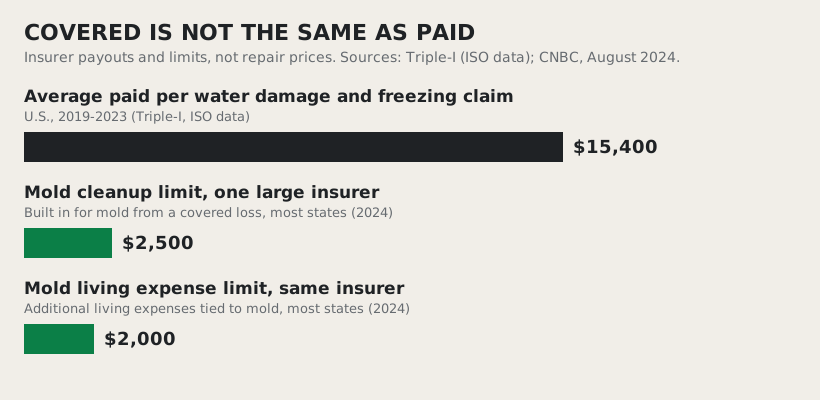
In practice, drying and rebuilding a soaked wall can fall under your main dwelling coverage, while the mold-specific cleanup falls under a separate, much smaller limit. USAA told CNBC in 2024 that for mold resulting from a covered loss, it includes $2,500 for cleanup and $2,000 for additional living expenses, at no extra premium in most states. Set that next to a $15,400 average water claim and you can see how a covered loss still leaves a bill.
| What it is | Amount | Where it comes from |
|---|---|---|
| Average paid per U.S. water damage and freezing claim, 2019-2023 | $15,400 | Triple-I, ISO data |
| One insurer’s built-in mold cleanup limit | $2,500 | USAA, via CNBC, 2024 |
| Same insurer’s mold living expense limit | $2,000 | USAA, via CNBC, 2024 |
| Mold limits one broker calls common | $1,000 to $10,000 | World Insurance blog, 2022 |
That last row is one insurance broker’s description, not a market survey, so take it as a rough idea. Your declarations page, or a mold endorsement if you have one, shows your real number. Look it up before you need it.
Flood is its own policy, and few people here carry it
Water that comes in from outside, rising out of a yard or a creek, is flood. The Pennsylvania Insurance Department says standard homeowners and renters policies generally don’t cover flood damage, and mold left behind by flood water usually falls outside the homeowners policy too. In September 2026 the department said only about 1% of Pennsylvania households carry flood insurance, even though all 67 counties have seen destructive flooding. There’s usually a 30-day wait before a new National Flood Insurance Program policy takes effect, so it’s a before-the-storm decision.
Closer to home, FEMA’s records show 91 active flood policies in the Gettysburg ZIP code, 17325, as of September 2026, 27 of them in the borough. The Stevens Run and Rock Creek page has the local flood record. Water backing up through a floor drain or a failed sump is a different coverage question again, usually handled by an endorsement; the sump pump failure guide covers that one.
What I’d do before you call the insurance company
- Stop the water and start drying. The EPA says wet materials dried within 24 to 48 hours usually won’t grow mold. That protects the house and the claim. The first 48 hours after a leak walks through it.
- Photograph everything before cleanup, and write down the date you first noticed the water.
- Read three parts of your policy: water damage, seepage or leakage, and mold. Then find the mold limit on your declarations page.
- Find the source. The first thing an adjuster wants to know is where the water came from and how long it’s been going. A moisture meter and a little detective work answer that better than a guess. Finding the hidden leak behind mold shows how it gets traced.
- Ask for a written estimate that lists drying separately from mold removal. If two limits apply, the adjuster needs to see which work goes where. What a remediation estimate should include explains what that looks like.
- If you’re stuck, the Pennsylvania Insurance Department takes questions and complaints at 1-866-PA-COMPLAINT (1-866-722-6675).
If you’ve found mold after a leak, call John Calhoun at Mold Remediation Gettysburg PA. I’ll find where the water came from, measure how far it went, tell you straight what needs to come out, and check that it’s dry before anything gets closed back up. The overview of mold remediation in Gettysburg, PA and my mold services cover the rest.
Where these numbers come from
The claim figures are national: Triple-I’s summary of ISO data for standard homeowners policies (HO-2, HO-3 and HO-5), which excludes Alaska, Texas and Puerto Rico. No public source breaks out water or mold claims for Pennsylvania alone. Mold limits come from an insurer statement reported by CNBC in 2024 and a broker’s article from 2022. Pennsylvania flood figures come from the state Insurance Department, and the Gettysburg policy counts from FEMA’s public flood insurance data. Every number on this page is what insurers paid or will pay, not a repair price or a quote.
Sources
- Insurance Information Institute, Facts + Statistics: Homeowners and Renters Insurance (ISO data)
- United Policyholders, Insurers deemed mold too risky decades ago (as published by CNBC, August 2024)
- Texas Department of Insurance, Texas Homeowners Policies comparison (2018, PDF)
- World Insurance, Does Your Homeowners Insurance Cover Your Home for Mold? (2022)
- Amica Insurance, news release, October 7, 2026
- Pennsylvania Insurance Department, flood protection progress release, September 10, 2026
- OpenFEMA, NFIP Redacted Policies (v3)
- EPA, A Brief Guide to Mold, Moisture and Your Home
More questions about mold and insurance
How common are water damage claims?
More common than most people think. Triple-I's summary of ISO data puts water damage and freezing at 1.50 claims per 100 insured homes a year from 2019 to 2023, behind only wind and hail at 2.80 in how often claims get filed. Put another way, roughly one or two homes in every hundred file a water claim in a given year. Those are national figures; nobody publishes a Pennsylvania-only count.
What is a mold sublimit?
It's a separate, smaller cap inside your homeowners policy that applies only to mold. Your policy might pay to dry and rebuild a soaked wall under the main dwelling coverage, then pay for the mold cleanup only up to that smaller number. One large insurer told CNBC in 2024 that it builds in $2,500 for mold cleanup and $2,000 for related living expenses in most states. Your declarations page or a mold endorsement shows your own number.
Will insurance pay for mold from a slow leak?
Often not. Many policies exclude constant or repeated seepage or leakage, and the wording varies. A 2018 Texas Department of Insurance comparison shows some forms draw the line at 14 or more days, some at weeks, months or years, and some at leakage that causes rot or deterioration. That's Texas, not Pennsylvania, but it shows why you need to read the exact words in your own policy.
Did insurers always exclude mold?
No. After a wave of large mold claims around the turn of the century, the Insurance Information Institute wrote in a 2003 whitepaper that some 40 state insurance departments had approved mold exclusions or limitations on homeowners policies. That's where most of the mold language people run into today comes from. It's old news to insurers and brand-new news to most homeowners.
Who can a Pennsylvania homeowner call about a claim problem?
The Pennsylvania Insurance Department runs a consumer line at 1-866-PA-COMPLAINT (1-866-722-6675) for people with insurance questions or who want to file a complaint. It's worth knowing before you need it. Start with your own agent or company first, keep notes on every call with the date and the person's name, and use the department if you believe the policy language supports your claim and you're not getting anywhere.
Have John find where the water came from
(717) 837-3115Request a mold assessment- Locally owned in Gettysburg
- Four years in business
- Independent, not a franchise